Mindfulness meditation’s blind spots, unconscious agendas, and hidden downsides, Part 4

A key tool deployed in mindfulness is detachment in observation, in the effort to maintain objectivity of awareness. But it’s a double-edged sword with an unacknowledged cost, and masks a deeper motivation. Similarly, breaking down experience into bits and pieces to elicit the perception there is “no abiding self” obscures one’s vision in another way.
Go to: Part 1 | Part 2 | Part 3 | Part 4

The alluring image of detachment

Much of the scientific or modern appeal of insight meditation comes from its detached methodology of observation, which mimics the modern scientific approach of attempting to remain as objective as possible. In these times of alienation and disillusioned idealism, not only is mindfulness the most scientific of meditation methods, but it is also attractive for the images of detachment it projects.

When one has been frustrated in their idealism or isolated in their alienation by our gigantic, technological, and impersonal culture, to have a method offered whereby one can work with these feelings in a different, more constructive or alluring way can be very appealing. In the process of meditative detachment, one can be removed from direct relationship with life processes that may be painful and not be as deeply affected by them. The equanimity that goes hand in hand with detachment can serve as a psychological buffer to provide a soothing balm for the inevitable dislocations of life in today’s world.

More fundamentally, though, masked by the practice of detachment is what amounts to an unspoken fear or distaste of emotional involvement in life. This hidden aversion is an unseen blind spot in mindfulness that originates in the underlying Buddhist philosophy of the “three marks of existence” (mentioned in Parts 2 and 3), one of which is unsatisfactoriness or suffering (dukkha). This is enough of a preoccupation in Buddhist psychology that an ultimate long-term goal of the entire practice becomes oriented toward not just reasonably minimizing psychologically rooted suffering but the Sisyphean task of avoiding it entirely.
Read more

Mindfulness meditation’s blind spots, unconscious agendas, and hidden downsides, Part 3

The reductionistic approach of mindfulness where experience and perception are broken down into ever-finer subcomponents is a key feature of the practice. The scientific flavor of this accounts for much of its appeal. But the whole is greater than the sum of the parts, especially in the psychological arena, which leads to the downside of reductionism in meditation — a blindness to gestalts.
Go to: Part 1 | Part 2 | Part 3 | Part 4

What has turned out to interest me most about mindfulness is how the underlying principles of the practice, along with the techniques that guide what is paid attention to, promote unnoticed agendas that become unconsciously buried.

This outcome is not simply incidental. These unconscious agendas, as well as oversights and forms of denial based on unacknowledged judgments and biases, are, surprisingly, part of the very structure of the practice itself. Because of that, these factors influence not only what one experiences and how it is interpreted, but just as importantly what one does not notice or see.

I hope the exploration here about how this could come to be interests you too, and helps in promoting an attitude of real inquiry — of looking beyond recommendations that sound good on the face of things, but may be overly simplistic or idealistic, and to always ask why.

Here, then, are a number of points about mindfulness as a practice I feel are consistently overlooked, even though a few of them may be given nominal consideration in passing from time to time, but which seldom seem to be addressed at any real length.

Read more

Mindfulness meditation’s blind spots, unconscious agendas, and hidden downsides, Part 2

Years ago, I felt drawn to mindfulness meditation but was strangely put off by it at the same time. On the surface, it seemed straightforward and transparent, but there were hints that not all was as it seemed. About that, though, insiders were mum. After outlining these issues, we take a reconnaissance flight over the terrain covered by mindfulness to get the view from 30,000 feet and set the stage for a more zoomed-in look to follow.
Go to: Part 1 | Part 2 | Part 3 | Part 4
Note: The critique here comprising parts 2 through 6 of this post series was originally written 30 years ago (with present-day additions and edits to repurpose it for the blog), and addresses the traditional version of mindfulness prominent then in the West known as vipassana. While this form of the discipline is still going strong, the currents of mindfulness today that have gone mainstream, while very similar, are a bit different in certain ways. One result has been to loosen up how the meditation practice is carried out.
Therefore, I leave it up to the reader to decide whether every single one of the criticisms made here applies with equal force to any given strand of today’s wider mindfulness movement they may know of. I hope the things we’ll be looking at prove useful in keeping your eyes open when exploring any kind of meditation in any of its potential forms.

Introduction: Stairway to heaven?

At one time in the past, I had for a while been drawn to and yet also was somewhat repulsed by — at the same time — the particularly exhaustive yet seemingly so ultimately simple practice that mindfulness meditation comprises. I was drawn toward practicing but eventually ended up abandoning the endeavor because there were a number of key things about the whole enterprise that kept “bugging” me.

On the surface, it appeared to be straightforward, transparent, scientific, methodical, repeatable, and unburdened by needless gibberish or nonsense compared to other approaches to meditation I had encountered or read about. There was no cultish demand to pledge one’s devotion to a guru. No superstitious mumbo jumbo, supernatural deities, or faith in unseen realms required.

It was based on one’s own direct firsthand observation of the inner panorama. There were no inscrutable or quixotic Zen koans or parables. No arbitrary meaningless mantras to hold echoing in the mind, ringing some internal Pavlovian bell like a carrot in front of a donkey, or swinging in the mind’s eye like a hypnotist’s pendulum to lull one into stuporous trance.

Instead, it advertised clean crystal clarity, spacious awareness, fundamental insight into being itself. And, ultimately, connection and oneness with one’s own underlying true nature, identical to and contiguous with that underlying existence itself. Look here, in this way, according to this procedure, it said, and you will see.

Read more

Mindfulness meditation’s blind spots, unconscious agendas, and hidden downsides, Part 1

Mindfulness practice is much-lauded these days, with seemingly few conscientious objectors. Criticisms that do exist focus mostly on peripheral concerns rather than the heart of the practice itself. Allow me to raise my grubby hermit’s hand and be counted.
Go to: Part 1 | Part 2 | Part 3 | Part 4

Back to the future

This multi-part post began as an article I originally wrote 30 years ago that never saw the light of day in any publication at the time — even the samizdat many-to-many and zine scene I was involved in before the internet came along. Not long after passing the pages around to a few acquaintances in the yoga community here in the U.S. for comment at the time, and discussing the implications between us, I xeroxed a few copies for safekeeping and then packed them inside a cardboard box along with other essays on such topics. In time, all trace of the piece eventually disappeared into the maelstrom that is our basement.

Over the years, the stapled pages inside their file folder survived a move to a new home as well as a few different basement clean-outs thereafter without ever surfacing. Eventually, I came to wonder if perhaps I had inadvertently pitched the article by mistake in some fit of zeal to flog into submission the subterranean chaos beneath our ground-floor living space.

Then one day during a recent deep-dredging operation, wading through the accumulated detritus of nearly half a lifetime, the long-lost screed unexpectedly emerged from the muck, clinging to other associated, long-submerged flotsam. And in reading through it for the first time since before my hair began turning gray, a thought arose: Maybe I should put this message in a bottle, cork it up as best I can, and send it out onto the open ocean of the internet to see on what shores it might land… before it can be sucked down for another deep dive into Davy Jones’ locker to be lost again, perhaps for good.

Read more

New neighbors, Part 3: Refugee cats versus our own — brokering a peace

Feeding tom-kittens Jack and Justin to help usher them through their rapid adolescent growth spurt wasn’t enough, by itself. Since their home base was right next door, they would also need to be integrated into our own brood of cats to prevent fighting with our two toms, which could potentially maim any one of them.
Go to: Part 1 | Part 2 | Part 3
Note: I have changed the names of the two neighbor cats in this post, and the preceding one, to provide anonymity for our neighbors out of respect for privacy. For the same reason I have not included any photos. I think it’s unlikely anyone in our neighborhood will read these stories, but you never know.

Roaming for food, seeking haven

As far as I could tell, Justin and Jack were fed at their place next door twice a day. Presumably they were fed in the morning right before or after being let out of the garage for the day, and again when being put inside again at night. On the other hand, perhaps they also had access to food ad libitum from a feeder overnight, although they were so ravenous when showing up at our place each morning, I doubted it. Or, alternatively, perhaps they didn’t much care for the food they were given.

I didn’t know any of this for sure, and could have been wrong. It was my best guess, based on the clues I could discern while keeping at arm’s length and not prying.

What did seem to be pretty clear, though, is that the two were put outside all day to fend for themselves. And when you do that with a cat, you can be sure they are going to try to line up other sources of food for themselves with sympathetic neighbors.

They will also try to secure secluded quiet spots and hidey-holes near preferred food sources for napping. They will scout out perches to serve as lookout posts or for keeping an eye and ear out for telltale signs food may be on its way. If they get caring attention from their benefactors as part of the bargain, so much the better.

Our own cats, with more frequent access to food, rarely wandered more than a half-block away, sometimes perhaps a block. Jack and Justin, though, had been spotted ranging as far away as two or three blocks from home, based on reports and photos posted by others in our neighborhood group online, as well as sightings by a friend of mine. Of course, part of this roving around could be attributed to the fact they were not neutered, but food is always a factor.

Read more

New neighbors, Part 2: Refugee cats at our door

When two hungry, rapidly growing, unneutered tom-kittens unexpectedly arrived on the scene — with a brood of our own cats to care for already — deciding how to deal with them wasn’t easy. Would I be overstepping my bounds to help them out myself? Or should I leave it up to owners who didn’t understand the Tao of Cats?
Go to: Part 1 | Part 2 | Part 3
Note: I have changed the names of the two neighbor cats in this post, and the post to follow, to provide anonymity for our neighbors out of respect for privacy. For the same reason I have not included any photos. I think it’s unlikely anyone in our neighborhood will read these stories, but you never know.

So where were we with the story of our next-door neighbors who moved in a couple of years ago, as we were wrapping up Act 1 of the tale? In a nutshell, the primary theme was: Nice people, but completely unaware of how the high level of daily, hours-long noise the family squalled out into the soundscape affected those around them. Particularly the constant whooping, hollering, and shrieking emitted by their five energetic, pre- and post-adolescent children.

Before moving on to the next chapter here about the neighbors and their refugee cats, though, there’s an interesting loose end to tie up that unexpectedly capped off the previous chain of events some time after I made the original post.

The conclusion of the initial installment of the story found my wife and me hunkering down, resigned to putting up with the ongoing noise for the time being, while contemplating a potential next move, but not eager to make one because of the potential confrontation or ill will it might generate. Because most of the noise comes during the warmer months, and particularly the summer when the neighbors’ backyard pool is open and in use, we got a long-awaited respite once the family closed it down in the fall of the first year they moved in.

For perhaps four months or so after that until springtime of the second year, we were able to enjoy some peace and quiet. Not complete, mind you, but with the noise level much reduced. With their five kids in school during the day in the colder months, and temperatures often too wintry afterward in the small slice of daylight left to play outside for long when they returned home, there was simply not as much opportunity to wreak havoc on the airwaves.

Read more

A mouse in my pocket

The pocket that held the mouse whose luck turned around.
Once in a while there is the chance to save a mouse from the carnage that goes along with owning cats who like to hunt. What difference does it make?

As much as I love our cats, one of the tradeoffs is dealing with the other animals they kill. Periodically, my wife or I will open the front door to find lying on our concrete porch a dead bird or mouse, or leftover mangled rabbit parts, lifeless before us.

My wife cannot face such scenes, and calls me in to take care of the mess if I haven’t yet come across it myself. Otherwise I will try to handle the cleanup of any blood or entrails, and dispose of the body, before she has a chance to see it, perhaps giving her a brief report later — if even that isn’t too much for her to hear.

While I’m not freaked out by the small, dead bodies and don’t mind the task itself, still, it always brings at least some pangs of regret or sadness.

Last year I remember finding a beautiful yellow finch at the foot of the short wooden staircase outside our kitchen door that opens into the attached garage, which is accessible via cat door and serves as another location where the cats leave their kills. Holding the finch in my hands, its eyes unseeing, but body and breast both still warm and supple, an emptiness arose inside and a lump came to my throat. Only moments ago it had to have been full of life. At the same time that you know cats are only doing what’s natural, your heart sinks to see such a beautiful, feathered and fellow creature — up close and personal, but gone.

Read more

On the run with Jim Walmsley and the kids (dream 9)

I am out again on the dirt roads, outside the hometown where I used to live decades ago, this time to the southwest of town, on a training run with the renowned ultrarunner Jim Walmsley. He is passing through the Midwestern plains and farm country here on his way across the country somewhere.

There are things about Walmsley I feel a kinship with that have led me to take an interest in him, and to follow the ups and downs of his career. But more than that, he is a wonder to behold in action: The loping, mesmerizing stride of a gazelle possessed by no other in ultrarunning. The superb, technically accurate footing of a mountain goat dancing effortlessly across minefields of scattered rock. Relaxed abandon fused with a relentless drive. A masterful grace evident in his easy handling of the most challenging trails. The agile coordination rounding hairpin-tight switchbacks. His confident facility breezing down twisting paths atop sheer canyon drop-offs.

And beyond that, there is the subliminal joy exhibited in the lilt of his limbs running even on the most prosaic terrain. Which is where we are presently, now that he has shown up on my turf for a run, unexpectedly, in a dream.

Read more

Gaining the luxury of time by doing less, Part 6

And now, after an interminable five-month hiatus, the thrilling denouement of the thinking person’s guide to slacking responsibly. Even fortified against the madding crowd by the numerous practical steps and information outlined previously, the way of “doing less” doesn’t happen without an ongoing shift in consciousness. In this concluding leg of our journey, we’ll look at what it takes to cover that terrain.
Go to: Part 1 | Part 2 | Part 3 | Part 4 | Part 5 | Part 6

Unless you’re convinced of the wisdom of doing less in today’s overbusy world — driving that point home is what Parts 1 and 2 were all about — significant resistance to actually going down this road will arise within. And, even with the knowledge of how thoroughly unhealthy America’s culture of overbusyness is, it still may not be easy to embrace suggestions for actually doing less, as you might have discovered while digesting the strategies and tactics outlined in Parts 3, 4, and 5.

This is because the way of doing less also forces you to confront your own preferences for, or addictions to, activities that may not be contributing to happiness in your life. Or in fact may be actively undermining it.

You may already know what some of these diversions are in your life but find yourself reluctant to give them up — a reluctance that might have been dredged up by the practical pointers covered in the previous three parts. Even the attitude itself of regarding activities detrimental to your deepest well-being as something to “give up” indicates an embedded or conditioned philosophy of always “wanting more.” Thus, if you do experience such reluctance, but still say you want to do less, then you have some internal psychological or spiritual “work” to do.

Successfully doing less and reaping the rewards of a more relaxed schedule requires that you take a psychological or spiritual journey (use whichever word you prefer). It’s a different kind of work than we’re used to doing for money or to keep our households running. Its entire makeup is different because it involves looking or feeling within rather than doing outwardly. In fact, the whole “way” of doing less embodies an internal shift to bring a better balance with outward doing by cultivating more looking, listening, and feeling. Not only within yourself but when it comes to the world around you.

Read more

Gaining the luxury of time by doing less, Part 5

Widen your horizons, and you’ll find a diverse array of strategies and tactics for taming the dragon of daily life, all enumerated here. Also not to be overlooked is the “mental game” where one begins to employ the less-is-more “jujitsu” underlying it all.
Go to: Part 1 | Part 2 | Part 3 | Part 4 | Part 5 | Part 6

The elephant in the room: our jobs

Our world is schizophrenic. Most people dislike their jobs yet fear losing them. But when people trust you enough to tell the truth, most will admit they would really rather not work — at least not at the jobs available — but do so anyway because they have little choice in today’s world.

On the other hand, when people are doing something they like, they aren’t lazy. They are enthused and put significant energy into it, though in such situations they tend not to overwork, instead finding an unforced rhythm of uptime and downtime. This is what natural activity looks like, not the scheduled-to-death lives so many of us live these days.

Best of all worlds: self-employment, flextime, or working from home

In the best of all worlds, this more natural rhythm of uptime and downtime would apply to our working hours as well. However, it’s usually only possible if you’re either self-employed or are employed by a company that allows you to work from home with compensation based on work performed rather than hours clocked. Carving out a niche for yourself in the business world as a self-employed individual, or landing a job with a work-from-home arrangement, though, is beyond the scope of this series of postings. But I highly recommend it if you have the personality, discipline, and motivation for it, and there are a few things I want to point out here.

Self-employment does potentially carry the trade-off of “feast or famine” periods where you alternately work more than you would like, but get unplanned periods of extended time off too. This pattern is well-known by many who make their living working for themselves. It all depends on the type of business you’re in.

Read more

Gaining the luxury of time by doing less, Part 4

Adding to our overbusyness today is the mirage of multitasking, which studies show actually doesn’t save any time at all. Far from promoting the practice, we consider how to tame its prime enabler — the smartphone beast, plus cover a few other tips. Multitasking by its very nature also helps breed and compound that gnawing emptiness inside you may feel. True satisfaction comes from a different direction.
Go to: Part 1 | Part 2 | Part 3 | Part 4 | Part 5 | Part 6

Doing one thing at a time

The illusion of multitasking

By now, enough studies have shown so-called multitasking actually increases the time it takes to get things done that it should be beyond dispute. We fool only ourselves when we believe doing multiple things at once increases efficiency.

And truthfully, don’t you often find it just plain annoying to feel forced to multitask? Wouldn’t it feel great not to? Wouldn’t you enjoy bucking a damnable trend like this — giving such a frustrating habit ye ole heave-ho?

Multitasking isn’t really doing things simultaneously anyway — it’s constantly alternating between more than one activity, and interrupting yourself each time you switch. Multitasking thus comes with numerous costs, has been shown to increase unhappiness, and can be harmful to your health due to increasing chronic stress. The work-related costs include up to a 40% loss in productivity and making more errors, the number of which increases with the complexity of the tasks involved.

Even simpler multitasking combinations such as smartphone use while walking can incur costs — nearly 20% of teens aged 13 to 17 and 10% of adults hit by cars while walking reported being distracted by their mobile devices at the time. Chronic “media multitasking” also negatively affects memory recall. Multitasking during cognitive tasks lowers IQ by about 10 points while so engaged. Also, studies show we are happiest when focusing on a single activity over shorter time periods of approximately an hour or less, while introducing variety of tasks over longer time spans of perhaps a day or longer.

Read more

Gaining the luxury of time by doing less, Part 3

In Parts 1 and 2, we documented America’s descent into a maelstrom of overwork and overbusyness, how unnatural it all is, and how unhealthy and unhappy we are compared to other developed nations. Here, in Part 3, we get down to the business, er, make that pleasure, of actually doing less.
Go to: Part 1 | Part 2 | Part 3 | Part 4 | Part 5 | Part 6

As I began putting together strategies, tactics, and tips for pulling back from the rat race, it became clear to me that many people would experience emotional resistance to them, despite the desire to do less. Reactions such as, “Oh, I could never give that up,” “I don’t have enough discipline,” “I don’t want to make that tradeoff,” “My friends’ feelings will be hurt if I don’t do such-and-such,” etc.

Which highlights the fact that the approach of doing less — scaling back — in order to reclaim a portion of your life from society’s excessive demands is not just a question of making changes to what you do during the week. Or changing the level of your involvement with certain habits or pursuits, or the pace of your daily activities. It is a psychological or spiritual journey as well. And in large part, that’s because we have internalized society’s demands on us and do not thoroughly question them.

Rather than cover that in this post, though, and delay getting into what it actually takes to do less in your life while still accomplishing what’s truly essential, we’ll hold off on the psychological and spiritual side of things for now. By first delving into strategies and tactics, and experiencing any psychological resistance that may arise along the way, we’ll be in a better position later to appreciate why “inner work” is so critical to the process.

I wanted to give a bit of a heads-up about that here first. Something to be aware of while we’re going through practical suggestions, so you’ll be ready for what might surface emotionally in response, and so you know what’s coming later. Ready? Let’s dive in.

Read more

Gaining the luxury of time by doing less, Part 2

America prides itself on its work ethic and role as the global epicenter of innovation and high technology. Yet it is at the same time the unhealthiest and least happy of the major developed nations. By contrast, primitive hunter-gatherer tribes that have been studied work the least, have the most leisure, and are much healthier. What’s wrong with this picture?
Go to: Part 1 | Part 2 | Part 3 | Part 4 | Part 5 | Part 6

How we got here, or… Here’s another nice mess you’ve gotten us into, Stanley

The age of too much to do in too little time we Americans are living in is not solely the product of something that has only become established recently, though it might well seem like it. Its ultimate roots extend deep into our past. The culture of overbusyness we find ourselves snared by is itself held in place by a worldview bound into place inside us largely by the unseen tendrils of Western religion that have grown up through the cracks of society everywhere. Or at least by religion’s darker side. (What? You thought it was all light and goodness?!)

Recall, for example, one of religion’s timeworn sayings whose job is to instill a collective “work ethic” disparaging downtime. The dictum “Idle hands are the devil’s workshop” goes back at least several centuries under different variants and is tightly tied to religious admonitions to stay busy at all times, in fear of some kind of unseen boogeyman.

Those outside the church walls may chuckle at such sayings, but nonetheless still cling strongly to the idea of the work ethic, probably viewing it as so self-evident it does not require debate. Nonetheless, the arguments for it are strongly morally tinged — the emotional baggage that goes along with it, and the guilt experienced if one shirks from it, have largely religious roots.

There are a number of other such strictures in Western religion against enjoying oneself too much without sufficient justification. Fortunately they have not been able to stamp out all unbidden leisure, but they do induce a significant amount of guilt over it for many. And that is perhaps the strongest mark it leaves on us, psychologically. Even when we do relax, we may feel we should somehow be using that time to “make something of ourselves.”

Read more

Gaining the luxury of time by doing less, Part 1

To disengage from America’s culture of excess so you can begin doing less, first you have to feel good about it. So to start with, Part 1 cuts loose with a rant flogging the nation’s collective psychosis of overwork, overconsumption, and overbusyness to help make it easy to jettison the guilt.
Go to: Part 1 | Part 2 | Part 3 | Part 4 | Part 5 | Part 6

Where the nation is now: looking into the funhouse mirror

In America today, we are living in an age of extreme excess and imbalance. Most do not see it, of course. We cannot see it, because nearly everyone has “drunk the well water” and regards it as normal. Even those of us who do consider this excess warped or perverse may still feel a certain amount of it to be unavoidable or inevitable: “Go along to get along,” in so many words.

But this excess and imbalance is not simply a matter of the country’s unbridled consumerism. Fueling our excessive purchases and collective philosophy of “living large” — otherwise known as “the American way of life” and famously termed “not negotiable” by President George Bush Sr. — is the other side of the coin of modern excess: working slavishly hard and feeling we need to keep busy all the time. For without these twin talismans of ambition, we could not pay for nor would we feel compelled to indulge in the overbusy, overconsumeristic lifestyle so many of us believe we should have.

Even with them, we still cannot afford some of our unrestrained purchases, and so with the addition of debt-fueled spending we can add “overextended” to the description of our outsize appetites. Below is a representative roundup of the most typical items in the nation’s lifestyle that keep us indebted to what we could call the four “O”s of overwork, overconsumption, overbusyness, and overextendedness.

Read more

New neighbors: the end of a long, quiet season

Go to: Part 1 | Part 2 | Part 3

Our new next-door neighbors moved in this past February, and we had introduced ourselves to each other and begun on good terms. But a few weeks later, I was regretting an outburst I had indulged in a moment of anger and frustration. An outburst that might have undermined the still-newly-fledged goodwill between us.

There had been ungodly noise coming from their backyard, a terrible screeching that continued longer and louder than I thought permissible for anyone civilized enough to be aware of the need for consideration of their neighbors. I assumed the noise must be coming from their five kids who at the moment were outside, hollering and shrieking as they played. Or perhaps it might be coming from some noisemaking children’s toy or device newly on the market that some money-is-our-god capitalist had struck gold with, now set to invade the already loud-as-hell American soundscape nationwide.

The kids had been very noisy on an ongoing basis almost from the beginning, which I tried to tolerate for a time. But this went considerably beyond previous intrusions: the straw that broke the camel’s back. Anger rising within me at the violation, my emotions began to boil over. I yelled over the tall, stockade-style wooden fence that hid the neighbors’ yard from view — as forcefully as I could without damaging my delicate vocal cords — “Hey! Hey! Can you pipe it down over there!?” No response.

The ungodly screeching continued. So I repeated my combined query and command, “Hey! Heyyy! Can you pipe it down over there!?” Whereupon I heard back from an adult male voice, “No!”

Read more

How the 12 new Hermit Spirit mastheads were designed, Part 3

Go to: Part 1 | Part 2 | Part 3
Images here are from Pixabay unless noted as sourced from iStock. For links to all of the fonts and original images used for Hermit Spirit’s site-wide and section mastheads, see Credits/Colophon.

“Reverie Massage Music Playlists” Masthead

Top Menu > Work > Reverie

After having focused on three business mastheads in a row, I was feeling the need to dive into something more fluid and nature-based, design-wise. In fact, that idea had been part of the impulse behind the main Hermit Spirit masthead itself. Or at least something with an organic, textured look, which is what I had originally planned as an underlying theme for most of the mastheads.

You can read more about the Reverie idea here, but in a nutshell, the playlists arose out of the need to put together the right kind of music to accompany regular deep-tissue massage sessions I began getting many years ago. Back then, I had developed repetitive-stress syndrome from years of computer work, tried several different things over an extended period to manage it, and found massage worked better for me in helping do so than almost anything else.

Over time I put together more and more playlists of different types of music, with a common thread running throughout: The music needed to be both relaxing but also captivating, even mesmerizing, for the one lying on the table, but also potentially energizing for the therapist. Definitely not the boring, insipid, saccharine, or sleep-inducing fluff that so much so-called yoga or spa music unfortunately seems to consist of.

When I decided to create a section of the website for publishing these playlists, I came up with the name “Reverie” to call to mind the daydreamy, absorbing mental state I intended them to elicit. So… when designing the Reverie masthead, what kind of image might best evoke that?

Read more

How the 12 new Hermit Spirit mastheads were designed, Part 2

Go to: Part 1 | Part 2 | Part 3
Images here are from Pixabay unless noted as sourced from iStock. For links to all of the fonts and original images used for Hermit Spirit’s site-wide and section mastheads, see Credits/Colophon.

“The Hangman and the Picture-Hanger Guy” Masthead

Top Menu > Work > Hangman/Picture-Hanger Guy

This was the next header I tackled after the Hermit Spirit blog masthead. Why? Well, the web page it sits atop brings in some extra inquiries for a gig I’m involved with that helps pay the bills. We’re talking basic “keeping the wolf from the door” motivation here. Despite the fact I wasn’t going to release the new website redesign until all headers were complete, I still felt an internal push to create the mastheads publicizing current income-producing endeavors first.

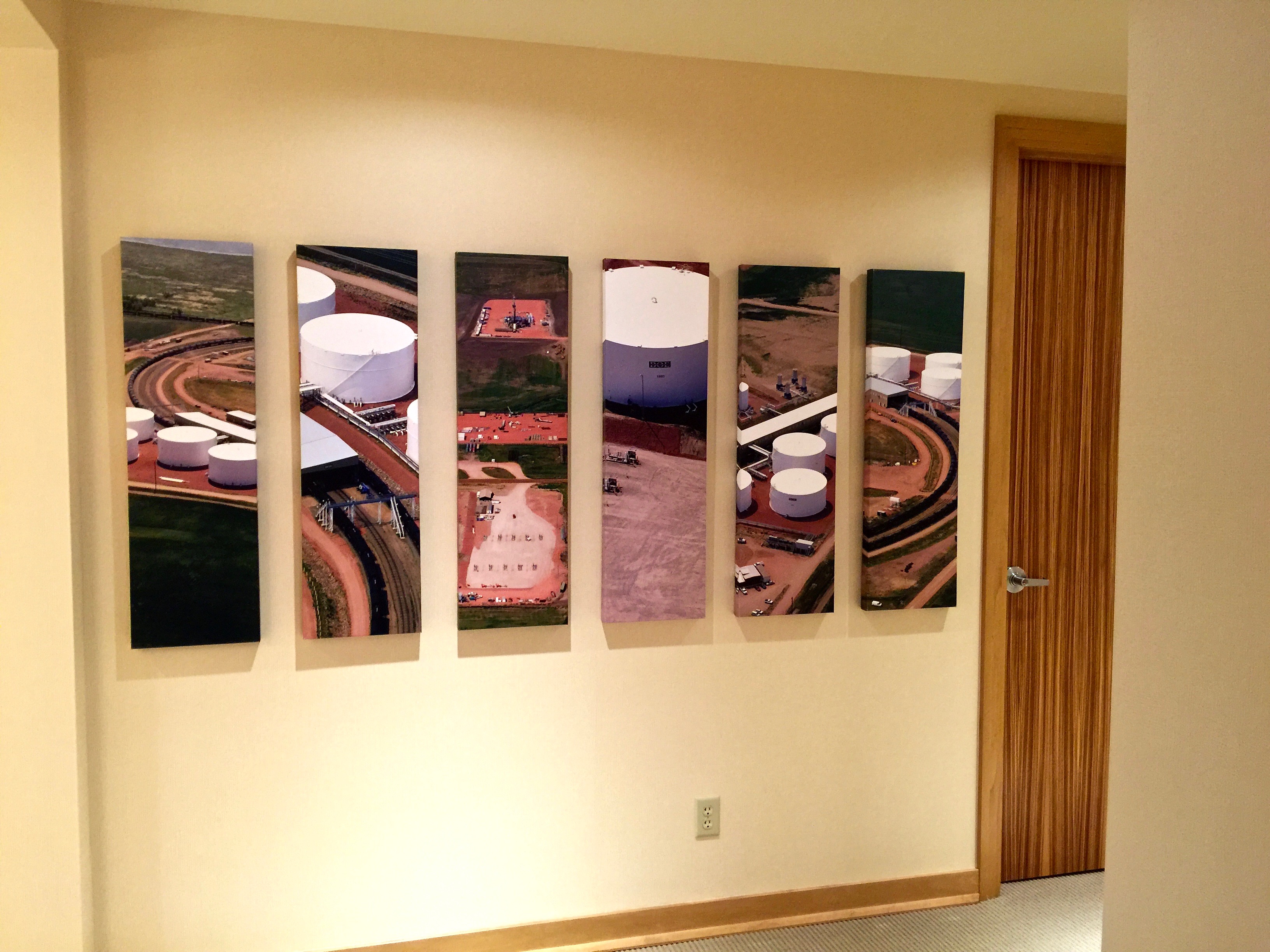
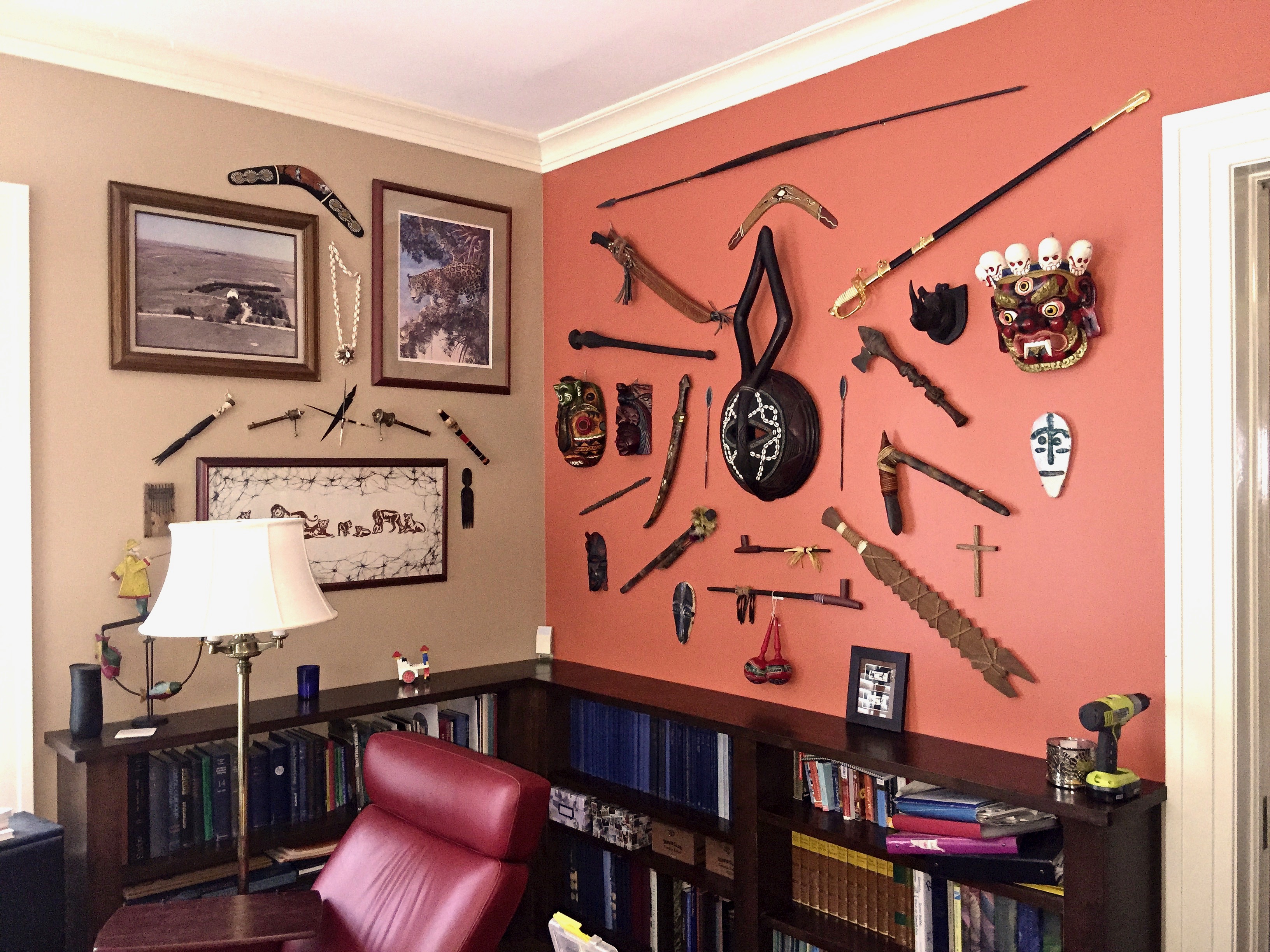
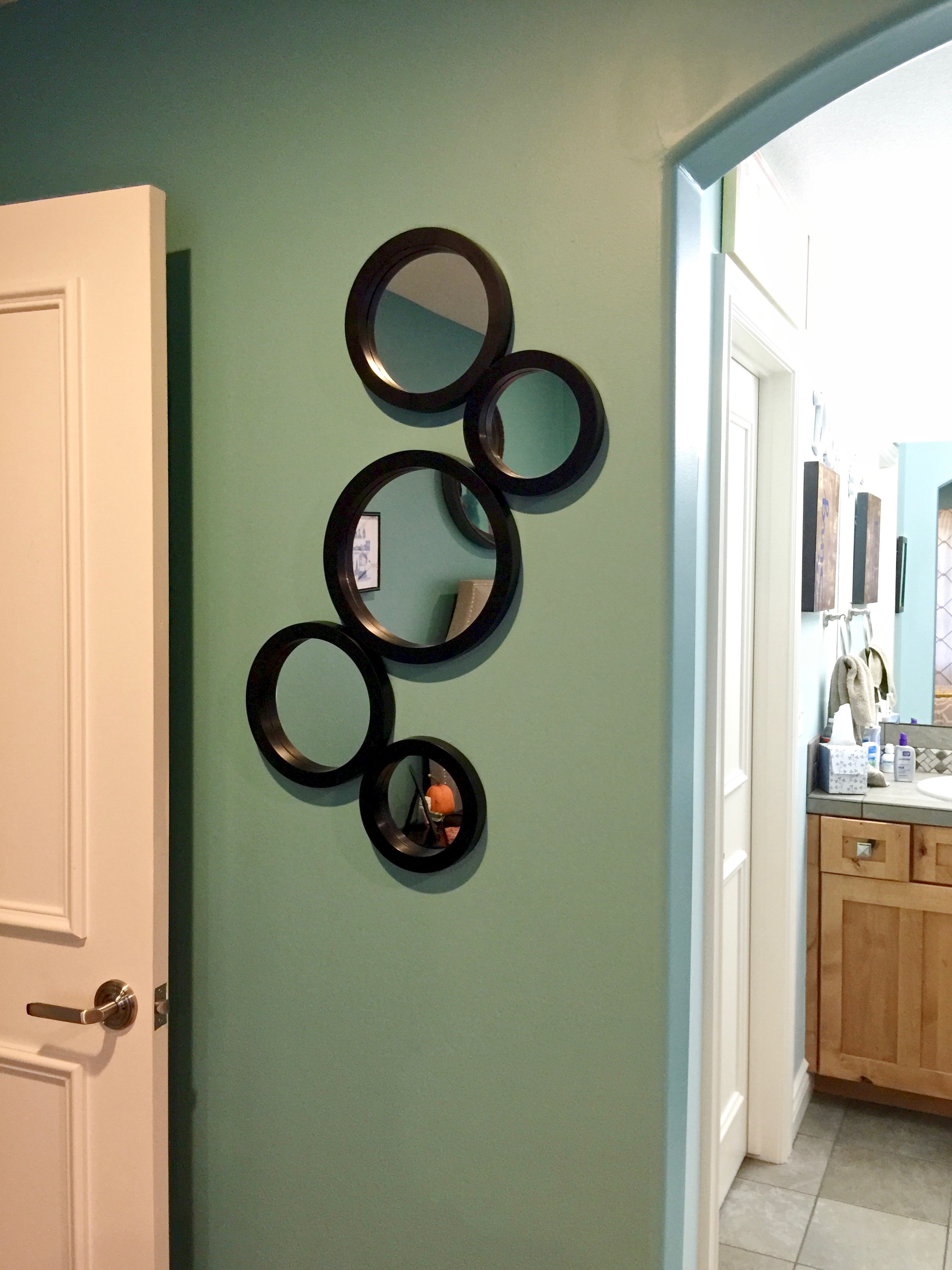
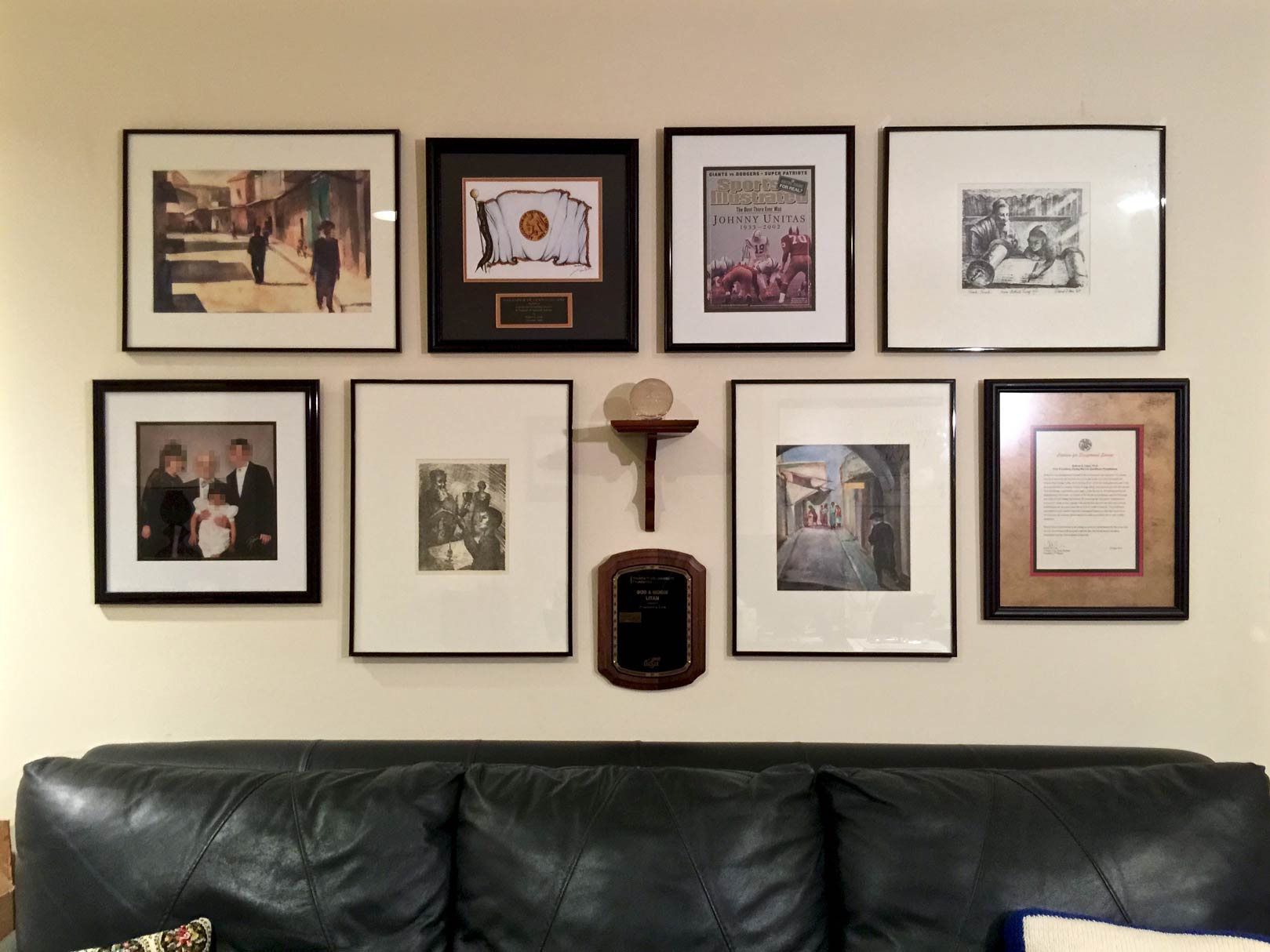
Unlike all the other headers, I didn’t need to search for any images to be used for this one. I’d taken plenty of photos with my smartphone of completed picture groupings and other wall hangings on actual job sites where my partner and I had worked. From those, I narrowed things down to the potential photos shown in the gallery below (click any image to enlarge):

In mulling over how many photos to feature in the masthead and how to arrange them, I realized three photos in the header’s central viewing area would be plenty. Otherwise the layout of the photos themselves would get too “busy,” and they’d need to be significantly reduced in size to fit the available space. That, in turn, would sacrifice graphic impact and good viewability. There was enough going on in any single photo to begin with, since virtually all of them featured groupings rather than lone items on the wall.

When selecting which photos to use, a key aim was showing that we don’t hang just pictures, but almost “anything on a wall” that can be hung. To illustrate that, for the three main photos I chose a large picture grouping we’d done, a second one showing antler mounts, and a third featuring unusual tribal artifacts.

Read more

How the 12 new Hermit Spirit mastheads were designed, Part 1

A look behind the scenes — and how things so often take longer than you think.
Go to: Part 1 | Part 2 | Part 3
Images here are from Pixabay unless noted as sourced from iStock. For links to all of the fonts and original images used for Hermit Spirit’s site-wide and section mastheads, see Credits/Colophon.

A week ago I launched the newly redesigned and rechristened Hermit Spirit website here after about two months of spare-time effort. Two major tasks were involved, the largest designing 12 brand-new mastheads for different sections of the site, including the home page/blog header. At the same time, I wanted to retain the typography and layout I’d previously developed for the main content area (body copy) plus the navigation menus, sidebar, and footer.

The latter task required porting the CSS, or cascading style sheets, from the preceding Think Outside the Box version of the site built on the now-defunct Headway theme into GeneratePress, which the current website uses. (Both are themes for WordPress.) I won’t go into the travails involved with the latter task because it’s code-intensive and not something most readers will care about. But I thought it might be of interest to take a peek behind the scenes at how I designed all the mastheads.

The main “Hermit Spirit” site and blog masthead

Homepage • Also: Top Menu > Blog

First, for comparison, here’s the previous Think Outside the Box blog masthead, followed by my new one for the retitled Hermit Spirit version. (Click on any image in this post to enlarge.)

You’ll notice two things off the bat: The new blog masthead is much simpler, and deeper vertically (at 400 pixels) than the previous one (286 pixels deep). I found that the Think Outside the Box masthead — designed primarily for computer monitors — lost most of its impact on smartphone displays, which are much smaller but have now come to be used for a significant percentage of all web surfing. So my watchwords for the new masthead series were larger and simpler.

Read more

Hermit Spirit blog conversion: interim report

Wardolfski turns over a new leaf with a reasonable-length post (say it ain’t so, Joe!), while his hermit self beavers away designing a new incarnation of the blog.

Things are going well with the website conversion, all things considered, with about five weeks of spare time now into it. I really enjoy the process of envisioning a new direction for any endeavor, whether something ongoing or a fresh start, especially the brainstorming side of things.

It’s a fragile endeavor, though, the ideas coming and going swiftly: for visuals, headlines, layouts. One must be on continual standby to note things down immediately, lest they disappear as evanescently as they flicker before the mind’s eye, trying to catch the proverbial lightning in a bottle. With pen and paper or a computing device at the ready, for a time prisoner of the muse or mistress. Pledged to do her bidding so as not to be cast out before you have obtained both satisfaction and release from your desire.

For me this stage tends to go by relatively quickly. Ideas typically come in a multitude of rapid staccato bursts — an experience of one “high” after another. While there can also be some cognitive dissonance as sometimes-contradictory ideas spew out like fireworks, it’s all part of the process.

As someone who enjoys learning new things and having my head turned upside down occasionally while simmering and percolating through to a new view, cognitive dissonance is to be welcomed because it means things are in flux. And flux, a boiling over of ideas, often chaotic, is a key aspect of the creative process. Eventually, as things evolve, the contradictions resolve themselves, and any ill-fitting pieces puzzled over begin falling into place. A direction progressively becomes clear, but as it does comes the challenge, the hard part: all the detail work required to implement the vision.

Read more

Crossroads ahead: renaming blog to Hermit Spirit. Here’s what’s up.

The best kind of change might be one that surprises you.

Over the last few months, I felt changes looming that I could not quite put my finger on. At loose ends on a few different fronts, first I found myself casting about for something to write on the blog here, but nothing presented itself.

Then, after an almost chance event — reading a rather off-the-beaten-path article on a blog about spirituality and meditation, a foundation stone that had once been important to me but had gone mostly dormant for many years — I realized it was time, I wanted, needed, to refocus my approach to life. I felt moved to revive and take up something again from the past that had fallen away, and once again move forward with it.

It was an impulse I had pushed down amid the incessant demands to make ends meet in today’s ever-onrushing world. Not always voluntarily, but something I had felt was necessary and had gotten used to, and perhaps even thought was a sign of the no-nonsense pragmatism needed to get along in life. Only now that approach was no longer working for me, as it had for such a long time. Now the impulse was returning, and it had not taken that much of a tripwire to do it.

In the past I had done some sitting meditation practice from time to time, but now, juggling more responsibilities and activities than I would prefer despite my attempts to place limits (the story of modern life, right?), I decided to try combining meditation with my evening walks.

Though I had been running several mornings a week, by the time evening rolled around, my body was often in need of some additional physical exertion, if light, to relax from the rigors or stresses of the day. So, I would go out for a leisurely walk around the neighborhood alone to unwind. Otherwise I could not always sleep well.

And… not initially too hopeful at first, I found the new approach to meditation worked. It wasn’t long before I began feeling more in tune with myself spiritually again, and was able to then pick up the inquiry I had left off with years before.

Read more

Making a new friend: the old, neglected running track

A locked-up track in the far corner of a public middle school’s grounds, going to waste. A fence-climbing 60-year-old runner who doesn’t realize his age. A long-overdue interval workout waiting to be performed, in need of just such an overlooked venue. Result: An affair between man and 400-meter oval.

It is winter in early February here on the windy Great Plains, and the last several weeks have been fierce, at least for running. Temperatures have turned unseasonably cold for long stretches, sprinkled with only a few warmer days to squeeze in key workouts — those either faster or longer.

To add to the difficulty, because of unfortunate coincidences recently, nearly two months have elapsed since my last track interval workout. Two consecutive respiratory colds of two weeks each, something that had never happened to me before, along with the harsh and unpredictable weather, have meant that for an entire month I have done only easy shorter or mid-distance runs for workouts while dealing with the sniffles, sneezing, congestion, and coughing.

Something that surprises most people is that continuing to run through respiratory sickness actually makes me feel better in most cases and weather things with less trouble. Still, beyond an easy pace and middling distance, it’s best to hold plenty in reserve and not risk overdoing during such periods.

A few times, energy level and lungs permitting, I’ve thrown in some 4 x 100m strides (that is, four very fast repeats of 100 meters each, just shy of a sprint) or 4 x 150m hill repeats here and there to try and keep the fires of speedier pace stoked a bit, but it hasn’t been much. Not enough to maintain the fitness level and more honed “edge” I seek, and that makes the training process as rewarding and enjoyable as it can and should be.

Read more

A makeover of old Bibles (dream 8)

I am inside an old church with my handyman partner Paul, with whom I once worked as an assistant in his business on a part-time basis. We have been called in for a meeting, weeks or months later, after a consultation we provided the ministers and other elders of the church. In this case it was not handyman services we provided, but a recommendation for how to reprint their old Bibles and other holy books. They are unhappy with how things turned out and we have been brought back in for them to point out what they do not like.

On handyman jobs, Paul is my mentor, the one with a lifetime of experience, and takes the lead in consulting with customers. In this situation, however, our roles are reversed. Here, it is me who has decades of experience as a typographer in countless situations with all manner of clients. Paul is along for the ride on this one, but has a good eye. I am glad to have him along, even if just for the company and moral support.

The denomination of the church is unclear, but it has the feel of a very old-line religion, not a newer Protestant or evangelical church. The interior architecture is of old polished woods, with light-colored stucco walls in shades of muslin, tan, and taupe. Aside from the walls, everything consists of dark browns and sepias. There is not much lighting, so the ambience inside is dim and overall somewhat dark. The atmosphere weighs on my spirits a bit.

I rarely pay much attention to clothing, but the ministers and elders I am talking with are wearing old, traditional attire of some type, not from today’s era. The feel is perhaps 1800s, possibly even 1600s to 1700s, depending on the man. There are no suits and ties as would be the case today. There are no women among the group. Everything is completely old school.

Read more

Picnic of champions: A reunion of out-of-shape athletic has-beens

An opportunity to connect with former university track and cross-country teammates from long ago does not go quite as hoped.
Names and a few identifying details have been changed out of respect for anonymity and personal privacy.

A white envelope

The envelope arrived in the mail unexpectedly one day this past summer. White and of regular correspondence size, with a computer-printed appearance of the type that suggested a mass-mailing, it appeared at first to be just another piece of junk mail.

With the flick of an eye, I glanced cursorily at the return name and address, which in part bore the acronym of my university alma mater. Probably another request to donate funds I did not have, I supposed. A plea from university boosters appealing to fellow former attendees now presumed to be economically prosperous.

A further glance, however, showed this normally on-target snap-judgment to be in error. I saw that the return address held the name of the man who had been coach of the university cross-country team for which I had competed my freshman year. On the line directly underneath his name were the words “XYU Track and Field Reunion.” And on the line beneath that, “Such-and-Such Place Assisted Living.”

This suggested something more worthy. While I had not cared that much for the coach, the lines on the envelope provided the telltale synopsis: An accomplished man now more frail, winding down his final years of life. Many former athletes whom he had coached, also aging, who had not seen him, or each other, for decades. A chance to get together, pay tribute, and catch up and relive old times with former teammates. And, perhaps, an opportunity to rekindle previous acquaintances, and see where things might lead.

Read more

Unknown Amanda Pelko (dream 7)

I am out exploring the rural dirt roads northeast of the small hometown of my youth, where I logged thousands of miles as a distance runner then. I have returned to be here for a morning, perhaps a day, just to wander around and soak up the countryside on foot. Things have changed in the decades since, but I still recognize the roads and surrounding land.

This place of pastures and farmland and barbed-wire fences, and the back roads running between criss-crossing it all was the center of my universe. Halcyon days. It feels good to be here again, refamiliarizing myself with the terrain, getting to know the land as it now exists years later, at least in this dream.

Every now and then, as the morning passes, I can see a lean, sinewy runner striding along from a distance. They appear to be in their element, their form honed as if they have been at this for years, as if they know their way around this locale.

I continue meandering along, following my nose, enjoying the luxurious hours. Halfway through the day, I decide to begin the return home and get a workout in at the same time. Home is an indeterminate west or west-southwest somewhere, so I head generally that direction along the perpendicular grid of dirt roads and begin running.

Not far into the run, about a quarter of a mile after taking a turn from one road onto another, I happen to look back and see the lean runner heading the same way I am, toward me. It is rare to see a serious runner in the area, and I would like to meet this individual. Maybe talk to them a little bit, and get to know more about them if they are willing.

Read more

Unintended things I’ve learned following other runners on Strava, Part 3

And now, the conclusion of our “Strava: The Awful Truth” rant (in so many words), wherein we wrap up our examination of the less-remarked-upon but often revealing aspects of participation in the popular social-media platform for endurance athletes.
Go to: Part 1 | Part 2 | Part 3

Many runners who compete at the local level don’t follow any structured workout plan

This may be one of the more surprising things I found on Strava. I grew up as a competitive runner starting at age 14, and was immersed from day one in the debates about easy runs and long runs vs. interval work vs. tempo and threshold runs vs. VO2max work, or whether to follow an overall plan of higher-mileage/lower-intensity vs. lower-mileage/higher-intensity, and so forth.

No matter where you stood on these issues, if you knew anything at all, you followed a training program that incorporated at least some kind of planned approach. Even if you didn’t or couldn’t follow the plan consistently, or “went by feel” when deciding whether it might be better on any given day to substitute a different type of workout for what you might have originally planned, you usually tried to get in a certain number of faster miles vs. slower miles, a certain amount of tempo or interval work, and so forth. It might have been more of a loose plan or template rather than a set or scheduled one, but when you looked at examples of training programs, the details tended to reflect one approach or another.

What has surprised me on Strava (well, somewhat) is how little rhyme or reason there is to most runners’ approaches to training, at least if you assume the majority of runners on Strava are more competitive types. It isn’t clear to me whether many just run entirely by feel, whatever that’s supposed to mean in terms of what types of workouts might be performed when, or if they truly don’t have much conception of how or why they might want to structure their training in a certain way in the first place.

Read more

Unintended things I’ve learned following other runners on Strava, Part 2

After having ripped at length on Strava’s “kudosing” silliness in Part 1, we turn now to the intriguing, odd, sometimes matter-of-fact, and occasionally mystifying things one can discover looking at other runners’ activities on Strava.
Go to: Part 1 | Part 2 | Part 3

A confession to make here: I am one of those guys who likes to go around turning over rocks, looking at the underside of things, just to see what there is to see wriggling around in typically unobserved places. Mainly because I find that the more of reality one can be aware of — whatever that encompasses in its various aspects — the more meaningful and understandable it is, and the richer the experience. And, sometimes, the more power and control the added insight gives you in working with it.

For my money, it’s not what you see on the surface of things, up on top in the light of day, that’s the most interesting. What’s more fascinating is what you don’t necessarily notice at first: the things hidden in shadow that come to light only later once you’ve managed to flip that rock upside down.

This applies equally both to the mechanical side of things and the psychological. If you’re a guy at least, for most of us there is always a certain fascination with what makes things function as far as the nitty-gritty “nuts and bolts” of it.

But even more fascinating, for me anyway, is the psychological underbelly. Why? Because what’s up on the surface is often just what people want you to see or, alternatively, perhaps only what they are conscious of communicating, which doesn’t necessarily jibe with what’s actually going on underneath. And any discrepancy between the two usually tells you a lot.

Read more

Unintended things I’ve learned following other runners on Strava, Part 1

Think that the most interesting things about Strava are the cool maps, graphs, and charts of your own and other athletes’ running, biking, and swimming workouts? Nope, not for me. What I have found more intriguing are all the things you eventually notice by reading “between the lines” that no one seems to talk about.
Go to: Part 1 | Part 2 | Part 3
Part 1 here gives the backstory about how I got involved with Strava in the first place, and also looks at what I consider the “Kudos trap” — kudosing being similar to liking someone on Facebook — that one can get sucked into there. (Yep, as usual, Wardolfski gets sidetracked composing what was intended to be a fairly brief intro, but then it really gets away from him.) The things I’ve learned from following other runners are covered in Parts 2 and 3.

Social media is not something I’ve ever been much interested in participating in, with rare exceptions. At least not Facebook or Twitter, both of which strike me as high school all over again. Not to mention that both are also just a cacophony of poor web design and poor usability — they’re frustrating to wade through and simply ugly to look at. I do understand that for certain groups of people or organizations or families, Facebook serves as the main clearinghouse for information, and can be valuable.

But for me, none of that applies. I tend not to be a joiner, if for no other reason than just because I don’t like the peer pressure, even if subtle, to behave a certain way that tends to come with participating in most groups.

Also, in groups, behavior tends to come down to the lowest common denominator, so things degenerate into either: (a) online flame- or slag-fests, or (b) the opposite, a bunch of meaningless Kumbaya or Pollyanna praise to whomever or whatever, or failing those, (c) people trying to top each other with clever one-liners, or (d) the feed gets polluted with too many jerks promoting either themselves or their wares. Or, (e) most common of all, the comments are just plain mundane, vapid, and uninteresting the majority of the time — a huge waste of attention span.

My response to all that is usually: No thanks. I’d rather go my own way in my own independent fashion. And then with Facebook, there are the privacy issues, which we needn’t get into here.

That said, I do have a fake Facebook account so that when needed I can log in anonymously to obtain needed info posted by someone there, but generally don’t bother with it other than that. I also signed up for a Twitter account a few years ago in an aborted attempt to try and help promote my self-employed work, but after a few tweets, the account has sat there silently since.

Once in a great while, though, I’ll make an exception for some online group or forum, if there’s enough meaningful “meat” to it to pull me in without too many of the above-mentioned cons. One of the online communities that has meant something to me has been Strava, the popular workout-logging and social-media site for endurance athletes — though perhaps not for the usual reasons many Strava users join, as it turns out.

Read more

The injured falcon and the abandoned little dog (dream 6)

I am seemingly outdoors, but yet inside our house. It does not quite make sense, because there is a tree overhead directly shading the floor inside. Be that as it may, however, there is a commotion going on: Our cats are chasing around under the tree, either after each other or something else — I am not quite sure which.

Then I see it: some kind of animal they are attempting to get at and toy with, standing on the floor. It is injured, but this time I do not think the cats are the ones who have been the cause, as they usually are with a small animal they have cornered.

I go over to see what kind of animal it is, and cannot tell at first. But somehow it has found its way just inside our back door. I try to take hold of it and carefully shoo it out the door away from the cats for its own protection, but am unable to get a grip on the animal. It is mangled and struggles to come back through the door. However, doing so will continue attracting the cats who will want to play with and kill it. Despite my shooing, the animal keeps trying to come back in the door for shelter, either unaware of or despite the cats.

Though I am unsuccessful trying to herd the animal out, I manage to find a way to keep it protected from the cats by stooping over and loosely cupping my hands around its body to create a shield, my fingers lightly brushing against it as I do. And as my hands make this contact, now my eyes become enabled to see the animal more clearly: I recognize it is a wild but hurt and grounded falcon that has walked its way, not flown, into our house in its injured state.

As I corral the falcon inside the lattice of my hands and outstretched fingers to protect it, it warms to my presence and begins quieting down and struggling less. Now I can also see that the falcon is no longer able to fly because something has stripped off too many of its feathers.

Read more

Are you hitting the point of negative returns with technology? (I am) Part 2

More from our disgruntled narrator in a salvo directed at some of today’s technologies that now bring as many, if not more, downsides as upsides to their use.
Go to: Part 1 | Part 2

Email gone rogue

There’s no doubt that email is very functional in today’s world of e-commerce. Like others with businesses to run, I rely on it heavily. Even though many of us now use texting and other forms of direct or private messaging or chat for many communications, email is still the lingua franca — the all-inclusive, lowest common denominator of electronic communications for conducting official business. The rumors of its death have been greatly exaggerated.

But that said, for me the number of unsolicited, unwanted email intrusions from non-work-related companies I’ve made purchases from at some point or other over the years has recently reached epidemic proportions. Several months ago it had gotten to the point where almost every day I was besieged with “news” or “special deals” or solicitations that I never signed up for from these companies. Legal companies, I should add, but nonetheless behaving badly.

Since I work in a deadline-oriented field where prompt responses are expected, by necessity I’ve set up my computer to notify me whenever a new email arrives that I need to know about. These alerts go beyond incoming business email from customers, and also include that from personal friends, billing notices, etc.

(I should note that these alerts only apply to a fraction of the email I receive, much of which consists of other types of email, such as recurring newsletters, notifications of website security scans and successful online backups of computer data, or discussion-forum emails. For these, I’ve set up rules to automatically filter or archive them sight unseen into separate mailboxes for later scanning or reference, should that become necessary.)

Over time, the number of unsolicited emails had become an ongoing burden that I increasingly came to resent, because of the Chinese-water-torture-like drip, drip, drip of unwanted interruptions that, cumulatively, were stealing my time — and therefore life — away from me on the installment plan.

Read more

Are you hitting the point of negative returns with technology? (I am) Part 1

A tale wherein our intrepid protagonist, who in the past has eagerly tried all manner of high technologies, becomes grumpy at the failure of newer entrants in the lineup to live up to expectations. With examples of his sacrilege in returning to lesser methods of doing things, and pontifications regarding the follies of the tool-using species known as homo sapiens.
Go to: Part 1 | Part 2

I am someone who has always enjoyed new technology. Most of my life, I’ve typically been among the first of my friends and family to try out what’s new on the horizon when it comes to higher-tech offerings. Or at least those that are affordable to people like myself of modest means.

This inclination is actually more than just a technological leaning, and extends to other new things as well: I became a distance runner in the early 1970s, at age 14, when we skinny dudes (and it was in fact mostly guys) running along the side of the road were thought to be odd and sometimes harassed because of it. At age 16, I became a vegetarian when it was considered countercultural and effete (but which I abandoned 18 years later after it began taking a serious toll on my health, despite my best efforts). Following in succession after that were also yoga and meditation.

Later, I became aware of and got involved with the internet in the late 1980s before most people had heard of it. At this time, email and email list forums (plus a few walled-garden forums like America Online, The WELL, ECHO, and CompuServe) were “the only game in town” on the internet for the most part. The Worldwide Web had yet to be invented, which meant no blogs, e-commerce, news sites, or social media. So with the internet still something of a desert in those days except for a few such oases here and there, I was then moved to explore the alternative realm of underground zines and M2Ms (many-to-manys) — the paper-based forerunners of today’s online blogs and message boards, respectively — before moving back to the internet once it began taking off for good in the mid-1990s.

None of this was because of any desire to be “up” on what was in vogue (all of the above pursuits were very much regarded as fringe at the time), but just because I’ve always been one to periodically cast about for interesting or challenging horizons to explore.

For example, I’ve also been keen on the latest research findings in science my whole life — something which most of the American public is anything but interested in, to judge by our students’ abysmal science scores and general avoidance of elective science classes in school compared to those in other countries. (Except, of course, when it comes to the fruits of science in the form of catchy, often frivolous new consumer gadgets, which the United States is the undisputed heavyweight champion of.)

Read more

Ovum in a baggie with embryonic flower (dream 5)

I am in the reception room of an in vitro fertilization counselor’s office, waiting for her to arrive for an appointment I have scheduled with her. In my hand I am holding a clear plastic, zip-lock sandwich bag. Inside it is a tiny, ovoid egg about 1/8″ to 3/16″ in diameter, with the color and finish of a white pearl.

It is my wife’s egg from one of her ovaries. We do not have any children — the dream situation is odd because in real life my wife is retirement age, and I am not far behind.

Read more

Work has begun on the FontCompass website

Earlier this year, in mid to late January, I finally bit the bullet: I decided to begin work on the long-haul endeavor of turning my private FontCompass universal typeface classification system into a website. Since then, most of my spare time has been devoted to it. Not that I have had nearly as much extra time as I would like. (Does anybody, these days?)

FontCompass began life a number of years ago. Initially it was a project I began putting together to organize my own font library just to speed my graphic design work, and I took the first steps sometime around 2005 or 2006. I’ve written up the basic idea here, but essentially the project was to serve two purposes:

  • To quickly identify typefaces used in customer logos for which they could not furnish me the original artwork, to enable speedily rebuilding them (assuming the fonts needed were present in my library); and
  • To locate typefaces with just the right “look and feel” I wanted for a design project. Since I was trained primarily as a typographer early in my career — and am to some degree a layout artist but not an illustrator or artistically trained graphic designer, which limits my “arsenal” — injecting some typographic allure is a key aspect of my approach to design. Without that, I don’t have a whole lot to offer that’s unique, so FontCompass helped tremendously.

After a year and a half of spare-time work, I had completed the task of classifying all the fonts in my own library, and the creation and buildout of the FontCompass classification scheme itself was also essentially complete. Mostly I used the system for my custom car tags business, Leeward Productions, rebuilding customer logos and designing tags. But it was readily apparent that FontCompass could also provide considerable value to other designers, as well as advertising agencies, if it could somehow be made available to them.

Read more

Invasion of the hobby joggers, Part 2

On the comeback trail in my late fifties after over two decades of running primarily for fitness, I discovered that the phenomenon of “hobby joggers” had significantly changed the road-racing scene. It was good that more people had found running, but couldn’t they have done so without crashing the party?
Go to: Part 1 | Part 2

When bigger is a bummer

Last fall, I was scratching my head after years away from competition, trying to find a road-running race where I would have decent room to run without literally getting tripped up. Sometimes race-event publicity and sign-up websites would proudly report the size of the event and how many participants finished the previous year’s race. Presumably they felt that this demonstration their race was a cool, super-duper “happening thing” would be a draw.

Most, however, did not mention the number, likely because they just didn’t think to do so, of course. I also wondered, though, if perhaps a few of the race directors or sponsors of these races might not want to broadcast how large their events had become for fear of appearing they had simply become too big, unwieldy, and crowded.

Because with too many entrants in a road race, logistics suffer unless the event is very well-managed: Insufficient, inconvenient, or distant parking. Delays picking up one’s registration packet and race number before the start. Lines at the toilets due to a lack of Port-A-Johns (and perhaps having to go find a tree quite some way off to pee behind). Faster runners getting stuck behind self-important but slower runners who have crowded their way to the front of the starting line where they don’t belong. And so forth.

Here’s the ironic thing. The races that come with the most troubles are exactly the ones that cost the most and are loaded down with the most crap: The useless participation medals just for finishing. The doughy, white-bread crowds pulled in by such trinkets. The unneeded water stations in short races like 5Ks. The gaudy carnival atmosphere with local radio personalities or other clowns polluting the soundscape with jangling, overamplified noise and pushing other foofaraw on everyone.

Read more

Invasion of the hobby joggers, Part 1

This past fall I got my feet wet running a few local road races again after many years away. In the process, I had to deal for the first time with the incursion of so-called hobby joggers that has affected the road-racing scene nationwide since the time I last competed. Here is my report.
Go to: Part 1 | Part 2

It is one of my first 5K races in almost 25 years, and I am now not much more than a quarter of a mile past the one-mile mark on a beautiful course that runs along the largest river in our state. It is an absolutely perfect fall morning for a race: 57 degrees, crisp air, a cheerful sun, and little to no wind or humidity. Cool enough to not overheat, but not so cool that my muscles might tighten up competing in the brief split-side shorts and T-shirt I am wearing.

At 59 years old, I am still feeling my way back from the long absence from racing. This current race effort is purposely more intense than my first couple of testing-the-waters forays the previous month, and I am beginning to feel and remember what a real competitive attempt is like again.

Flirting with the limit of my current fitness, I am pushing hard but consciously holding back a bit to avoid going over the edge so I don’t crash and burn. And also because I’m still not quite sure where that edge really is, or exactly what it feels like — or used to feel like — after such a long time away.

I don’t want to risk running on the “red line” just yet. I’m getting closer to that day, but it can wait till next spring. After the two earlier fall races run well shy of my capability, this one is a time trial to wrap things up for the season and assess my true fitness level so I can determine a few key paces to target in training this winter. So while I’m enjoying grappling with the challenge, I don’t want to spoil things by potentially overreaching and nosing over into a painfully drawn-out tailspin for the latter half of the race.

A first encounter with the species

Not far ahead of me is a younger, tallish, somewhat overweight (at least for a runner), probably early-thirty-something man who is laboring heavily. It is a level of fatigue he should not be experiencing until the very last half-mile of the race, had he been pacing himself properly. He appeared in my sights a couple of hundred yards back, and I have slowly been closing in on him. But now, crossing over a bridge spanning the river on the route, with every stride the gap is visibly diminishing.

Read more

Running renewal at age 59: turning over a new leaf with “Tinman” training, Part 2

Continuing our look at the training approach of Tom “Tinman” Schwartz, and its clarifying, rejuvenating effect in motivating my return to racing after many years away.
Be sure to check out the Tom Schwartz training info links at the bottom of Part 2 here, which point to articles, podcasts, and videos exploring his approach in more depth. If you find yourself drawn to train the “Tinman” way, don’t overlook the very helpful training calculator tool on his coaching site that’s linked to below as well.
Go to: Part 1 | Part 2

The art of “Tinman” training: putting the pieces together

Other than perhaps his take on “CV” intervals that purposely target Type IIa fast-intermediate muscle fibers to significantly increase their endurance (covered in Part 1), Tom Schwartz isn’t promoting anything completely new, of course. But then again, no one can really claim that mantle.

Most competent coaches and training systems these days incorporate multi-pace training year-round now, for example, varying the mix depending on the season. But the way Schwartz balances all the different elements is, if not unique, rare these days, and he consistently offers interesting, outside-the-box insights you tend not to find elsewhere, as well as simple, practical ways to apply them to training. And his deep knowledge of the history of training systems, his extensive education and training in exercise physiology, 25+ years of coaching experience commencing very early as an undergrad, and holistic grasp of how everything works together in concert — or should — is unparalleled.

Here are a few high points and key takeaways, to expand a bit on what was covered in Part 1.

VO2max intervals: easy does it. Schwartz does employ VO2max intervals as part of the overall system, but carefully and judiciously, specifically eschewing too many of them, at least by prevailing standards, even during the peak season. They are done less frequently, over shorter distances, and in significantly less volume per workout than insisted on by most coaches. This runs very much counter to the “conventional wisdom” these days.

But Schwartz has found through experience that most distance runners do not need much of this type of training to perform at a peak. A little goes a long way, and it is easy to overdo and burn athletes out. And besides, races themselves in the 1500m to 5000m range hit the body’s VO2max physiology hard as it is. Depending on how often an athlete races during the season, little additional VO2max-specific training may be needed beyond racing itself.

Read more

Mother sister pregnant moon (dream 4)

This is a dream from 10 or 15 years ago that I happened to remember recently. Nothing special was going on in my life at the time, at least that I experienced as being particularly noteworthy.

I
t is the wee hours, about one or two o’clock in the morning. I am outdoors lying on my back in a grassy meadow.

It is a pleasant, warm, quiet night. A full moon bathes everything in its blue-white glow, in which I am basking.

I am still myself — a man. But I am fully pregnant and moments away from giving birth. It will not be a son or daughter, however. The person I am about to give birth to is… Myself.

There is no pain, just an exhilarating, quietly radiant joy suffusing my entire body and mind. I am completely in the moment, anticipating what is to come, yet already fulfilled, wanting nothing more, nothing less. My whole being is full, my heart filled.

As I look up, I see my mother and my only sister standing above me in attendance. They do not say anything but they too are happy, quiet, and expectant.

I am at complete peace, awaiting what is about to happen.

That is all.

Running renewal at age 59: turning over a new leaf with “Tinman” training, Part 1

Years down the road, with new motivation after a long hiatus from racing, I am finally taking the opportunity to try making a little hay from lessons I began learning about training long ago. Only recently have those lessons finally sunk in enough to make a difference.
This two-part posting includes my selection of “best of Tom (Tinman) Schwartz” links at the end of Part 2. These point to articles, interviews, podcasts, and videos covering his views on training, plus Schwartz’s handy online training calculator for targeting specific training paces based on a current race performance.
Go to: Part 1 | Part 2

Why race again after so many years?

It’s curious how life will sometimes toss a bone your way. In some cases it turns out to be just a dry bone lacking in marrow, and is better passed over. Other times, though, you gnaw on it a little, hesitantly at first, a bit distractedly, and then find, perhaps despite yourself, your appetite is whetted. Then with a little more nibbling and tentative chewing, the juices begin to flow.

What you might have viewed at first as something not really worth the extra bother, you begin to embrace. Then as time passes, you find yourself pursuing it with an extra enthusiasm you had tabled or forgotten. And you outstrip the original idea and begin taking it further than originally intended.

This happened for me recently when the idea of running a local 5K road race together “just for fun” was suggested by a running friend of mine. For a dozen years, I had been content to run a couple of days a week for fitness and general enjoyment, because I had always loved running and training just for their own sake. In earlier years, I had been involved in high-level competition — for several years in high school and college, and for another period in my mid-30s — but thought that “fire” had been burned through already. I did not anticipate ever competing again.

Read more

My distance-running story: the bridge from past to present, Part 3

Sometimes lessons have to be learned more than once, or in more than one context. Or they may be learned incompletely or only in retrospect. There may be many fallow years where little learning at all seems to take place. All of these played a role in my experiences across the years with longer, slower mileage-based running versus shorter, more intense training. Now things have come full circle with the chance to try again and tie it all together.
Go to: Part 1 | Part 2 | Part 3

I cannot now remember the exact reasons why my running began tailing off after college. It wasn’t any single thing, but a number of them. It wasn’t the fact that I was no longer competing, because I had continued running for another three or four years on my own after my first and only university cross-country season as a freshman.

Maybe in part it was the fact that, not long after graduating, I had embarked on my first serious love relationship. But beyond the overwhelming nature of the “new life experience” that the relationship represented for me, I was exploring other new things in-depth at the same time: Eastern philosophy and alternative consciousness, meditation, yoga, organic gardening, the idea of appropriate-scale “small is beautiful” technologies, and so forth. (This was the early 1980s just after the flowering of these movements in the 1960s and 70s.) All of this impacted my drive and motivation for other pursuits.

Then there was the new network of friends and acquaintances I was introduced to through the relationship. As well, without a clear career direction to pursue after college, despite a degree in business (for me, a fallback since I did not know what I wanted to do), I felt buffeted about. To make ends meet, I took a fairly physical job for a couple of summers and the intervening year working as a golf course greenskeeper, which siphoned off some of the physical energy required for a discipline like running.

After that, I got a job in computer operations that lasted the better part of a year, with a huge manufacturer in the area, running room-sized laser printers that spit out incessant financial, inventory, and other reports for the company bigwigs and other white-collar corporate drones, and that paid fairly well. However, it required working third shift, which played havoc with my schedule and put a damper on my energy levels. After a full week off from the job at one point, I felt so much better physically when back on a normal daily wake/sleep cycle that I realized third shift was detrimental to my health, and I needed to make a change.

Partway through this stint, then, I decided to go back to the university for classes in computer programming. The idea was to take advantage of my natural facility with computers — still a relatively new thing at the time — to springboard into a new career like a co-worker I was friendly with, who was avidly pursuing a burgeoning interest in programming. This way I would be able to lift myself up and out of the looming specter of what could otherwise become a future of corporate dronedom, just like that of the company hacks my stacks of laser-printer output fed.

Unfortunately, the added schedule of university courses loaded me down more, both physically and mentally, of course. After a single semester I couldn’t endure the grind any longer, and lost interest.

Read more

My distance-running story: the bridge from past to present, Part 2

The initial flush of success that I experienced my first, and only, season running competitively in college turned out not to be worth it, at least on my terms. I quit the team but kept running on my own, and explored longer runs for the exhilaration and satisfaction of it. I also got in great shape, though I had nothing to show for it outwardly. But that was okay by me.
Go to: Part 1 | Part 2 | Part 3

My freshman year in college, I managed to pull off an accomplishment that I was perhaps more proud of than anything I had achieved previously, competition-wise. Paralleling earlier events when I made the high school varsity cross-country team my freshman year (covered here), the same thing occurred when I made 7th and last man on the university varsity cross-country team. This time it was as a walk-on, beating out all the other college freshmen, most of whom had some kind of partial running scholarship.

But it wasn’t because I was any better than them, really. My inborn talent was decent, but except for two or three out of the eight freshmen — one of whom was a walk-on as well — based on our previous competitive results in high school, while fairly close to the others in ability, I was perhaps not quite at the same level.

Whereas on my high school team the previous year I was one of the unelected de facto workout leaders who tended to set the tone by example — unfortunately helping beat most of us into the ground on interval workouts — on the university team it was just the opposite. My body just couldn’t take all the hard-effort, collegiate-level training that the other runners could, even most of the freshmen, so I started sandbagging in workouts when needed just to survive.

By this time, I had learned enough to know when my body’s capacity to absorb punishment was being exceeded, and when to back off and take an easy day with a slow recovery run. But since that wasn’t fully possible in the university team situation, at least to the degree I really needed, some days I would just lag behind as much as I could, whatever the workout for the day might be.

Read more

My distance-running story: the bridge from past to present, Part 1

Most of my competitive years in high school and college were a time of learning how to train on my own. Simultaneously, I was coping with several different coaches along the way, most of whom did not have a very good idea of what they were doing. It made for a career of ups and downs and unfulfilled potential, yet also fun times and hard-won training wisdom learned along the way.
Go to: Part 1 | Part 2 | Part 3

Despite always having loved running for its own sake (see The Earth at My Feet for the story), I was so motivated by achievement and competition when I was younger and competing in high school and college that it sometimes worked to my detriment. Often, I went into competitions having “left my race on the training track,” so to speak.

I was well aware of the value of longer, slower, “mileage”-based training (i.e., what is sometimes termed LSD or “long, slow distance”) to lay a distance base, to be complemented by faster interval-based workouts — either concurrently or later in the training cycle. However, once the competitive season got underway, I/we (my teammates as well) still often overdid the latter at the expense of the former.

This was not entirely of my own choosing, since too much hard track-interval work was thrust upon the distance runners by coaches who didn’t know any better. However, even had I been entirely on my own, I still would probably have overdone it to some degree.

In high school — this being the era of the 1970s when 100 miles per week for national and world-class runners became the holy grail of training — I put in as much mileage as I reasonably could, given my teenage, still-maturing body. At that time I was averaging about 50 miles per week over the course of the entire year, but the weekly mileage distribution was bimodal. I piled on more miles in the off-seasons when training on my own, at least 60 and sometimes 70 or 80 miles per week. But during the competitive seasons (about two and a half to three months each for cross-country in the fall, and track in the spring) I could only manage about 40 miles.

Read more

Self-made programs at a funeral, and a drink on the road (dream 3)

I am attending a funeral in a town a couple hours’ drive from where I live. Earlier this year, in real life, my sister and her husband and I had made the drive together to attend a funeral in this same town for an aunt of mine who had lived a long life.

But in this dream, my aunt is still alive. She and my sister and I are attending the funeral of another woman, someone I don’t know. It is a bright spring morning.

We are walking on a cemetery sidewalk in a line with the other people paying their respects, toward the graveside ceremony. There had apparently not been the usual memorial service in a church or chapel beforehand. A typical small, foldover program for the occasion has been handed out to everyone attending.

Glancing over the four pages of the program, I notice that the information about the deceased is very sparse to the point of being almost nonexistent. My aunt explains as we’re walking along that each person is to draw and compose their own program for themselves.

Read more

The Earth at my feet: why I ran back when — why I run now

Sometimes, after the spiral has turned many years later, you discover the things that motivated you in the beginning are still what motivate you in the end, after other things have fallen away.

The first day I decided to become a distance runner, when I was 14 years old, I went out and ran four miles around the local lake just outside my small hometown. This was without any prior training, to speak of. It was not an easy effort, but not terribly difficult either — somewhat challenging, but it came naturally.

I had no special experience related to running other than a very active childhood playing outside just about every day exploring the neighborhood, taking part in little league sports, and running short sprint races against friends in local grade school and middle school competitions, or during playground recesses from time to time.

When it came to running specifically, as with these short races, I did nothing much longer than sprinting probably 75 to 100 yards, or playing games like “tag” where one might be continually moving for some time but running or sprinting only for intermittent short bursts. As far as track and field went, I had been more into long-jumping and pole-vaulting in the preceding years during middle school. Golf was also a pursuit, affordable to a wide swath of the middle and lower-middle classes in those days, and all of us except some of the adults walked and carried our own clubs around the course, rather than riding in carts.

Prior to the day mentioned above, I had gotten my feet wet a few times in the preceding weeks, running solo time trials of perhaps a mile and a half around the local neighborhood streets, but no more than that, just to see what I could do.

The second day, I ran four miles around the lake again. And each day after that I continued to run four miles or so, trying out different routes for variety. But immediately I was running almost 30 miles a week.

Starting out with distance running like this did not seem that unusual to me. I had always had more endurance than the other kids, whatever the game we were playing. Others always wanted to quit before I did. I did not have a high energy level, but the ability to endure had seemingly always been there.

Read more

Emerging online after 15 years of radio silence, Part 3

Why would one stay away from public participation on the internet for so long, after having been so active before that? Why begin writing again online now? The time had come.
Go to: Part 1 | Part 2 | Part 3

An inner imperative for absence

Introversion and peaceful time away

With the internet having increasingly become a roiling and turbid fishbowl, what a lot of the preceding reasons for opting out covered in Part 2 really boil down to is my personality type as a serious introvert. Once I went to the sidelines, it didn’t take long to begin luxuriating in being out of the spotlight.

The internet is a curious double-edged sword if you’re an introvert. On the one hand, with a website or blog you can write and post from the sanctuary of your own home, while still interacting with people from a distance. On the face of it, this is less demanding and stressful than doing so in person. While I do okay in my personal life dealing with people one-on-one whom I don’t know, still, as an introvert, it is always going to be somewhat stressful unless it takes place in an intimate atmosphere with close friends you implicitly trust.

However… with conversations in person, at least people you don’t know tend to demonstrate basic politeness. The internet, on the other hand, seems to invite people to sound off with unbridled opinions and untempered emotions. This inevitably leads to conflict and people just itching to shoot down another person’s statements.

Getting out of practice with conflict. Conflict is something most introverts do not like. With email forums and then the Beyond Veg website, over time I learned to develop a thick skin and not take things too personally. But doing so isn’t a once-and-done thing if you’re an introvert — it doesn’t come naturally, at least not in my case. It’s something that’s an ongoing discipline or practice, as is simply being in the public eye more, and knowing how to handle yourself.

If you’re not keeping a “skill” sharp, you get rusty at it. As I got out of practice being on the sidelines for months and then years, the inertia of staying there took on a momentum of its own. Now that I am “putting myself back out there” online again, I’m attempting to do so in a more quiet, personal way. This is not to say that I am always one to avoid conflict. Push me far enough, and if the arena is something I am knowledgeable about, I will respond with as much ammunition as called for. Respectfully so, in most cases, but with no holds barred intellectually.

Read more

WordPress’s hidden hazards for do-it-yourselfers, Part 4

Okay, troops. The final installment in the series here requires only that you slog through another 4,000 words from the master of verbosity, so buck up. Considering you’ve plowed through almost 12,000 words already (at least if you didn’t skip anything, you dirty rats), this is gonna be a cakewalk.
Go to: Part 1 | Part 2 | Part 3 | Part 4

Examples of plug-ins to remedy core WordPress deficiencies

Below are some plug-ins I’ve been pushed into using simply because something silly is either missing from core WordPress functionality, or is seriously deficient. Things that you would think would be — and should be — built in as standard, but where the developers are just being obstinate or clueless (pardon my presumptuousness). When it comes to the needs of the average user, code geeks truly are a different species often living with their heads up… er, in the clouds ;-).

  • 404page. Wouldn’t you think that the typically clunky, stock 404 (“Page Not Found”) error page would be easily user-modifiable to your own liking? I, for one, thought that. I’ll bet you think that too. Silly you and silly me for thinking something so obvious should be so easy. It ain’t. I kid you not, the WordPress developers apparently think you are just going to jump up and down with glee knowing you’ll need to larn yerself some of that thar PHP coding and go in like a surgeon to modify or code your own 404.php page to get the job done. And that you’re a chump if you can’t or won’t — so there.
  • The 404page plug-in makes it as easy as falling off a log. Just like it should be in the first place. Create your own 404 page the way you would any other WordPress page, use this plug-in to point to it so it’s substituted for the default version of the page, and you’re done. Slam dunk.
  • Broken Link Checker. If like me, you’ve ever used an application like Dreamweaver to create websites, you probably think broken-link checking is an obvious, standard feature that would be available with any capable web publishing software. Wrong-o. Sorry, the core WordPress developers don’t think like you and me.
  • Evidently you’re supposed to be so accurate that you never cut and paste a link erroneously, and links never go bad. Or maybe they think you enjoy blowing an entire weekend from time to time doing nothing but clicking on the links throughout your site to see if they still work or not. Because, well, because gosh, it’s just so cool that you can, like, click on a link on a web page and it might take you to potentially anywhere else in the cyberverse. I mean, wow, just WOW, think of the possibilities!

Read more

WordPress’s hidden hazards for do-it-yourselfers, Part 3

What? Didn’t get enough punishment from the first two parts in the series? Good. Let’s continue on, fellow masochists.
Go to: Part 1 | Part 2 | Part 3 | Part 4

Plug-in proliferation

So, you’ve decided on an off-the-shelf WordPress theme of some sort or are going to roll your own. But you need extra functionality. What about plug-ins? First, here’s a contradiction you run into all the time. Everybody says to use plug-ins for extra functionality so you avoid theme-vendor lock-in. But at the same time, everybody also says don’t use plug-ins if you don’t have to. Why are people talking out of the other side of their mouth here? Three reasons:

  • Plug-ins are security risks. Many plug-ins are poorly coded, and most WordPress sites that get hacked are compromised by exploiting plug-in vulnerabilities.
  • Too many plug-ins can slow down your site.
  • Plug-ins can conflict with each other. (See above: many are poorly coded.) The more plug-ins you’re running, the more potential for conflicts. Even with plug-ins that are well-coded, conflicts might still occur on occasion.

Obviously, you can’t both use and not use plug-ins at the same time, right? What gives? Part of the problem is admittedly the poor quality of so many plug-ins. This is purely my own personal opinion, but based on the reviews I see on WordPress.org, along with my own experience trying out different plug-ins, just as a rough guess I would say at least 50% of the plug-ins out there shouldn’t be listed. At least. As a minimum. They either don’t work as advertised, performance may be slow, they may have poor user interfaces, aren’t kept up to date, aren’t well-supported, or, well, you get the picture.

Keep in mind this rule of thumb: The more something is democratized, the lower the bar is typically set, and the more crap will be let in the back door — heck, the front door. I’m not saying democracy is bad, but it comes at a cost, often a significant cost. The cost is all the rabble that’s enabled. WordPress is an open-source CMS platform, and the most popular, which means anyone can write a plug-in. Caveat emptor.

Read more

WordPress’s hidden hazards for do-it-yourselfers, Part 2

Continuing with round two of the complain-a-thon and avoiding-the-pitfalls advice for WordPress do-it-yourselfers.
Go to: Part 1 | Part 2 | Part 3 | Part 4

The WordPress theme landscape: an unorganized polyglot of a mess

N
ow, what about the design of your site? Another initial hurdle to clear when you’re first beginning on the road to a self-hosted WordPress site is what it’s going to look like. It’s basically a three-fold choice:

  • Use one of the stock WordPress themes (Twenty Ten, Twenty Eleven, Twenty Twelve, etc.).
  • Go with either a free or premium theme from a third-party developer (i.e., Themeforest, Elegant Themes, or any one of a boatload of other developers).
  • Roll your own.

The stock WordPress themes: ah, ugh. I think the first observation to be made about themes for self-hosted sites is that the stock themes offered by the WordPress core developers mostly suck. It’s not just that the themes are minimalist, because minimalism can be good, but that they are minimalist in a clunky way that just isn’t visually very pleasing.

Perhaps one shouldn’t complain too much about this since the core WordPress developers are primarily coders, but this is a recurrent issue you typically see with any kind of open-source software: the user interface and particularly the graphic design of things are often a serious weak spot. Coders’ brains are just wired differently than most people’s, and specifically they are wired differently than people like graphic designers who are strongly visually oriented.

But if that weren’t enough, coders for some reason almost seem to operate under the hubris of “we don’t need no stinkin’ visual design,” which of course is just the opposite of the truth. More than any other group, coders should be seeking help with the visual design of things, and yet they seem to be the last to acknowledge the need. Or if they do acknowledge it, are painfully slow to actually do something about it.

Read more

WordPress’s hidden hazards for do-it-yourselfers, Part 1

Planning to create your own WordPress site and just rarin’ to have at it? Or already in hip deep and dealing with alligators lurking all around? Slow down there just a minute, podner. There are some things you should know that the “experts” may have forgotten to tell you. Consider these words from someone who doesn’t have their identity tied up in cheerleading for the platform, with a realistic view about what to watch out for.
Go to: Part 1 | Part 2 | Part 3 | Part 4

Although I am not a WordPress guru, it seems to me for that very reason it would be worth offering my perspective on WordPress’s numerous “gotchas” and unseen hazards for first-timers. Because until recently I, too, was a first-time WordPress do-it-yourselfer — having put together my own site here in the nooks and crannies of spare time I was able to carve out over the last year and a half.

Although I had prior experience hand-coding a couple of previous (small) websites, combined with 30 years under my belt as a typographer and graphic designer, plus an all-around career background in various forms of publishing, there was still a significant learning curve of hard-won trial and error I was forced to go through with WordPress before arriving where I’d been aiming in the first place.

Such a vantage point has given me more of a skeptical eye toward the supposed straightforwardness of the process that I believe most WordPress “experts” may not really appreciate. If they ever truly had to go through it, they have long since passed this learning stage, and often seem to forget what it can be like for lesser mortals in the beginning before you have your bearings, but still need to make decisions about what to do.

Experts giving advice are often coders. Most do-it-yourselfers aren’t. Experts on WordPress tend to have significant blind spots, in my opinion, because of how “close” they are to the guts of how the platform works. Not only that, due to what is often a lack of background in design and editorial matters (WordPress gurus tend to be most comfortable with coding, site function, and site architecture considerations), they often overlook addressing important but unspoken questions everyday users have when it comes to wrestling with WordPress.

With a career rooted in design and editorial concerns, I have expectations for how good publishing tools should behave and what they should offer that may be somewhat different than what’s typically covered on the topic by the mainstream WordPress community of experts. After having built out my site here and finally getting it running on a more or less even keel by this point, I have been struck both by WordPress’s many positive aspects but also its numerous, often unremarked-on limitations, at least when initially used straight “out of the box.”

Read more

Neanderthal America: the grocery store

Every now and then you just feel like letting loose with a real rant. Here’s one on how a typical shopping trip to the grocery store has become a microcosm of everything our country now seems to stand for.

When I first began writing this post, its working title for some time was “Introvert Hell: The Grocery Store.” That’s because I am by nature an introvert and find most grocery stores here in the U.S. to be loud and oppressive places, with their dense press of humanity, blaring public address systems, and omnipresent, rumbling refrigeration compressors creating a constant din wherever one goes inside. (To name a few items as a start.) And since research suggests one-third to one-half of the population are introverts — despite the widespread disregard for us in this country’s implicit promotion of the “extrovert ideal” everywhere — there would have been no shortage of potential readers.

But as I took down notes it became apparent there was more to my dislike of grocery shopping than simple introversion. Grocery stores today, like many other things in this country, are a microcosm of the larger society. They reflect much about our guiding value system and collective behavior.

So to enlarge the scope of the post title to cover everything on the agenda here, I thought a better-fitting phrase for the range of things at issue would be the more provocative “Neanderthal America.” Which to me is largely what the U.S. has devolved to in recent decades, as the country has passed its former heights as the leading nation others once looked up to, but now is past its prime, like an aging prizefighter, still full of chest-beating bluster, but lacking discipline, vigor, and not least, intelligence.

Read more

The personal impact of industrial decline, here and now

The classic features of the decline and fall of civilizations in historical times have been well documented. So have the economic and other macro-level problems besetting our own society in recent decades that strongly suggest it, too, has now started down its own inexorable path of decline. What have not been so well described, though, are the more intangible but equally real aspects of modern civilization’s decline that we experience in our everyday personal lives.
Since this post is lengthy… If your time is limited, you can jump straight to the concluding side-by-side comparison chart summarizing the numerous ways our personal lives today differ from the USA’s pre-decline years.

A lot has been written in certain corners of the blogosphere about the macro aspects of the long decline of modern Western civilization ahead of us, like that of ancient Rome, currently in the initial stages of washing over our world. There are plenty of predictions about where it will take us, debates among fast-crash advocates vs. slow-crash, the forms it may or may not assume, and so on.

Of course, outside this circle, many if not most probably believe the current ills of our technological civilization are a temporary detour that will be righted once we get back on course — whatever that is thought to be. In conservative religious circles it is believed the proper moral course is all that is needed. In the business community, the right economic policies will be our savior. In the high-tech community, innovation. (Innovation in computers and iPhones continues! What, me worry?) For those of political bent, no matter what political party, it is a better vision and stronger leadership in government that will save the day.

Direct vs. indirect effects. However, while there are numerous statistics about the more or less stagnant economy, joblessness, the increasing number of families with children on food stamps, and the widening gap between the rich and the poor along with the hollowing out of the middle class, little has been written about how breakdown and decline are experienced by those of us seemingly buffered from the worst impacts — what most of us feel at the personal, individual level. And the decline does affect just about all of us, not only those who have been directly hit by one or another personal disaster.

Blind spots and self-blame. Certainly many people these days are affected acutely by job loss or income decline — or perhaps are managing to maintain their income by working longer and harder, only to see prices for essentials continue to rise, and these are serious impacts. I know a few people myself who have gone through or are going through such trials. To me, all of this is a given. But it has also become apparent to me how even the more commonplace, everyday aspects of our lives are affected by the decline going on around us. Yet these characteristic experiences we share tend to be “blind spots” in terms of failing to realize how strongly they point to the larger decline going on around us, or blaming ourselves for our responses, until one wakes up to the larger picture.

Read more

Emerging online after 15 years of radio silence, Part 2

Just when the controversial Beyond Vegetarianism website I had created in the late 1990s was enjoying success — at least on my own terms — I “dropped out.” And this, just as the web itself was undergoing rapid expansion. Rather than branching out into something different or simply taking a temporary breather, I withdrew from public participation instead, for 15 years, as it was to turn out. Why? Here are the reasons.
Go to: Part 1 | Part 2 | Part 3

As mentioned in the conclusion to part one, at the time I decided to pull back from public participation on the internet around the year 2000, the Beyond Vegetarianism (a.k.a. Beyond Veg) website that I had created a few years before had more or less accomplished my original goals for it. Other sites with allied views were now joining in to add their voices to the mix, which provided more momentum in raising awareness of the paleo vs. vegan dietary issues we had helped spearhead. It was good to see this unfolding.

The initial reason why I opted out

Gradual onset of repetitive stress injury

While the influence the website was having in its corner of the internet was satisfying, I wasn’t thinking about that as a reason for moving on at the time I dropped offline. I hadn’t really stopped that long to assess where we were at in our trajectory. That came more in retrospect in helping to support my decision. At the time, I just wanted to find the solution to a case of repetitive stress injury (RSI) I had been dealing with for a while prior to Beyond Veg, but that had gradually become more and more serious.

Read more

Everything I never wanted (dream 2)

I am in a palatial, multistory building with floor upon floor, room upon room. All the furnishings are sumptuous and well appointed with impeccable taste, but I do not feel particularly enthused to be here.

There are many people busy doing things in this building, but the people I am nearest to are focusing their attentions on me.

“Here,” they seem to say. “This is for you. Wouldn’t you like to do such-and-such, or to have this?” — this nice thing or this experience that is what one should really like, or be doing.

But none of it interests me.

I realize why. It is like The Truman Show movie in a way, with everything revolving around me. Except unlike the movie, it is not that they are secretly manipulating my experience for the benefit of a TV series, or for others. The purpose isn’t to leave me in the dark within a larger story scripted for the entertainment of an audience. Instead, it is being done openly to convince me of things the others are enraptured by but I am not, so that I will join in with them.

A number of luxury items that would have cost significant sums to design or create are shown to me that most anyone would desire and feel flattered to be presented with.

But the people in this place want me to buy into their experience in a way that I do not, or cannot. I am not moved, and so they only try harder to interest me.

Read more

Achieving enhanced web typography, by a 30-year veteran

Enhanced typography is still difficult to achieve on the web — well over 20 years after the web’s inception, no less — and by now should be much easier, to my way of thinking. As a professional typographer for 30-plus years now, I thought it might be helpful for others to explore how I went about putting that aspect of things together here on Hermit Spirit.

This overview takes a look at the various typographic elements I’ve given special treatment on the Hermit Spirit blog and website, including a number of WordPress plug-ins that have been utilized. For those who are more intrepid, what’s covered in this post should hopefully be enough as a jumping-off point to help get started implementing these solutions as well. Although I had experience hand-coding a couple of previous websites (HTML and CSS, though not more advanced code like JavaScript or PHP), I myself could certainly have used an overview like this over a year ago when I began trying to get Hermit Spirit going in my spare time using WordPress.

Read more

A trifold dream

It is a Saturday morning during wintertime. At about 7:00 a.m. I wake up to go to the bathroom and then to the kitchen for a snack. As usual the cats are milling about, clamoring to be fed in their gentle way. We are temporarily out of dry kibble, since I hadn’t had time the previous night to refill their dry-food storage canisters upstairs from the long-term supply of bagged food in the basement. (If we keep bags upstairs, one or another of the cats will eventually claw them open.) I had skipped the chore to get to bed at an hour at least approximating something halfway decent.

After the cats have been fed some unexpected and always-appreciated canned food, instead of the usual kibble at this hour, I head back to bed for more sleep. It’s the weekend and I want to catch up. With enough sleep, I am myself, and I’ve been overworked and a little short of it this week.

I drift back to sleep. Then at some point I am in a dream. I am in a small town the size of, say, a small university town. Bigger than the town of less than 10,000 I grew up in, but still small compared to the cities where most of us live these days. (Having grown up in a small town, I prefer them to cities.) In the dream, it’s a gray day — the type of day I generally like, except it’s somewhat cold, and some snow and slush are on the streets. I find myself in the downtown area of this small town, with ice skates on. I begin skating over the pavement, and even though the snow and ice are melting away, I can still skate over the last remaining bits, more or less.

Read more

Life sucks, and then you die — as reworded by the world’s major “isms”

The Real Meaning of Life

Life sucks.

—Buddhism

Life sucks, so what?

—Taoism

Life sucks, and then you die.

—Existentialism

Life sucks, over and over and over again.

—Hinduism/reincarnation

Life sucks and you’re going to heaven or hell afterward, but you can’t know for certain which one.

—Old Calvinist predestination Christianity

Life sucks and you’re going to heaven or hell afterward: Do you feel lucky, punk?

—Updated for today’s more modern Christian

(nod of the hat to Dirty Harry)

Read more

Emerging online after 15 years of radio silence, Part 1

In the late 1990s, I launched a controversial website — Beyond Vegetarianism — that was at or near ground zero for both the vegetarian and paleo diet movements on the early web. Why would someone who formerly had much to say disappear from the internet for 15 years? Especially at a time when the website was going strong, and just as the paleo movement it had helped publicize was gathering real momentum?
Go to: Part 1 | Part 2 | Part 3
The first several sections of Part 1 here are a retrospective partly for people who knew, or knew of, me “back when” as the guy who created BeyondVeg.com and who was allied with the early paleo diet movement online. These sections provide perspective on my motivations at the time, which were often misinterpreted, and tie up some loose ends. When I eventually dropped off the scene at the time, it was done without much of an explanation, if any.
For those without close familiarity with vegetarianism and paleo diet, these initial sections should help give an idea of what the “veggie vs. paleo” landscape of the times was like, and the role Beyond Veg served, as I saw it.
Whatever your familiarity with any of this, though, if you’d prefer to skip the initial retrospective sections, you can jump to the main part of the story here, recounting the “prequel” years leading up to Beyond Veg, its formation and growth, and then the aftermath.

The “Beyond Veg” website I started in the early days of the web established its position then by drawing a few different lines in the sand that provoked controversy. First, by publishing the earliest widely referenced debunkings of vegetarianism’s claim (at that time) of being the original human diet. This we accomplished by also being the first online to translate and present in plain English the findings of peer-reviewed science on paleoanthropology and human evolution as they pertained to diet.

My motivation was not debunking for debunking’s sake, but because I myself had been misled into believing the above claim. And, following advice based on it had delayed my recovery from health problems by a few years. Perhaps I might help others avoid the troubles I had undergone and not also lose months or years to inferior health — time they could not get back.

I also wanted to set the scientific record straight. While many if not most in the vegetarian movement probably did not base their adherence to the diet primarily on the belief that humans’ biological dietary adaptation was originally vegetarian and presumably supported by evolution (or the Bible, some believed), still, it was part of the “canon,” more or less. At the least, vegetarianism’s status as more whole and “natural” than the indiscriminate standard American mixed diet was usually a selling point. And it was true it was more natural in terms of its inclusion of a large proportion of whole plant foods — if one also ignored its omission of meat. So Beyond Veg’s debunking of that omission as unnatural and less whole did not sit well, at all.

Read more

Cats versus kids: the choice is clear

Honestly, kids don’t have much going for them other than carrying on the family name. And you might have very good reason to fear even that. Cats, on the other hand… Well, by almost every other measure, they’ve got kids beat by a country mile.

From the cost to raise them to their agreeable nature, disciplined habits, all-around respectful behavior, and athletic ability — from toilet training all the way through the teenage years — it’s not hard to find a slew of reasons why you might find a cat preferable to a kid. Why anybody in their right mind would think otherwise is hard to fathom. In fact, once done reading these 36 reasons, you might well be itchin’ to find the nearest merchandise return counter to exchange your snotty hapless kid for a felicitous furry feline.

  1. You can raise six cats for the cost of one-quarter of a kid.
  2. You don’t have to pay for cats to go to college.
  3. Cats won’t owe student loan debt the rest of their life and yours.
  4. Cats come in five or six different fur colors.
  5. Kids scream. Cats purr.
  6. Cats will still cuddle with you on the sofa after they’ve grown up.
  7. Kids will move back home to live on the sofa after they’ve grown up.
  8. Cats know how to pee in the box right away and don’t need to be potty-trained.
  9. When a cat meows back at you, you know they appreciate you. When a kid talks back, it ain’t the same.

Read more

“Think Outside the Box” blog: beginnings

Note: “Think Outside the Box” in the post title refers to the name of the blog here before it was changed to “Hermit Spirit.”

After fifteen years with no personal presence on the internet, events over the last year or two have pushed me into gearing up to become active again. It has been a “long time gone,” as well as a long time reaching a turning point where the time feels right and I’m now ready to surface online again beyond just lurker mode.

Read more

css.php